)
)
)
Interview with Richard Hammond & The Smallest Cog
- Event: Classic Car & Restoration Show
- Date: 21 March 2026
- Speaker: Richard Hammond and The Smallest Cog Team
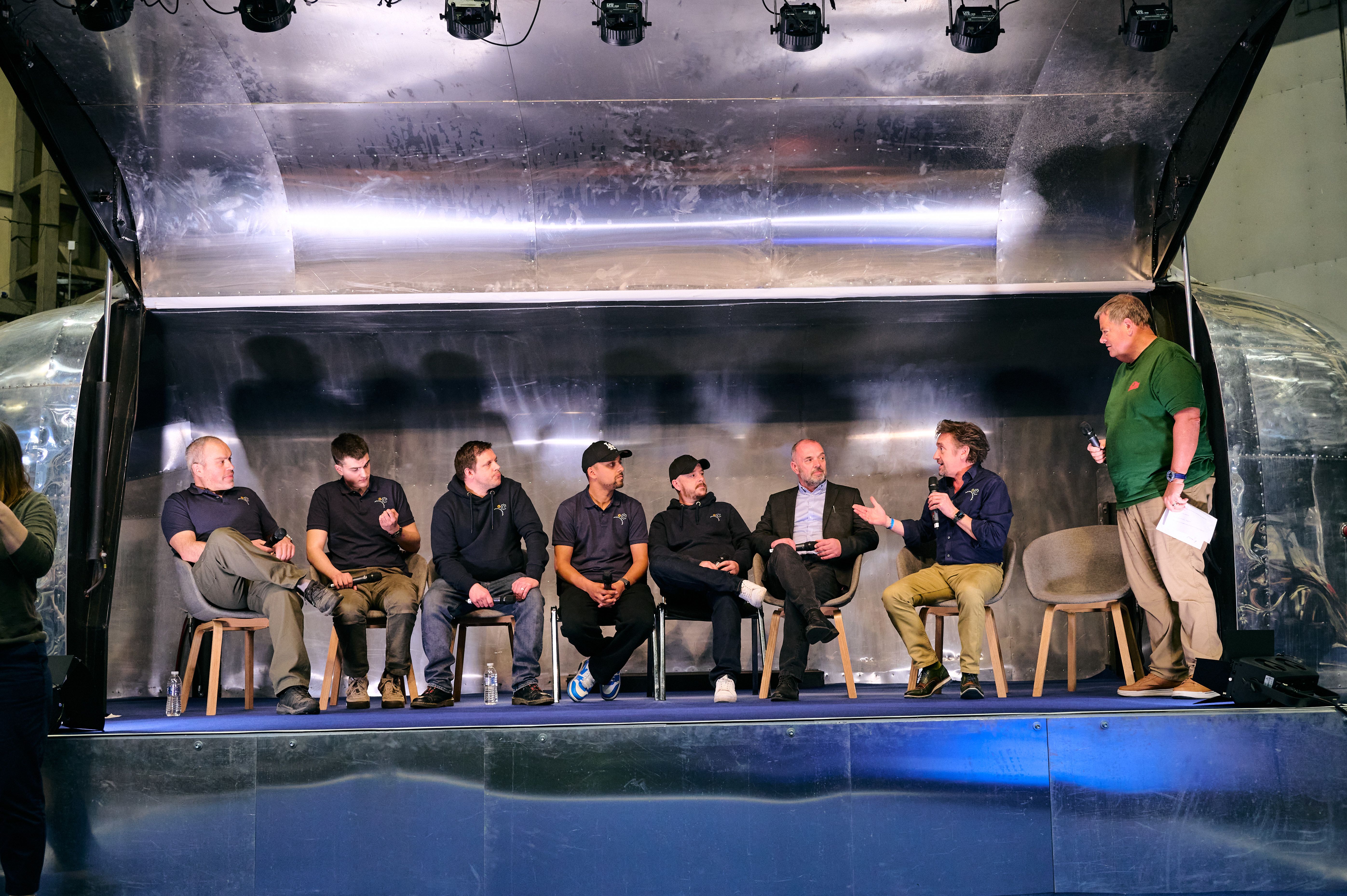
Five years after opening the doors of The Smallest Cog, Richard Hammond and his ever-expanding team took to the stage to share the realities, challenges and excitement of building a modern classic car restoration business and to unveil perhaps their most ambitious project yet.
For fans of the Discovery+ series, the familiar faces were all there, but the message from the team was clear from the outset: while television cameras may follow their work, The Smallest Cog is first and foremost a genuine, working restoration workshop.
“We’re not a TV show,” Richard explained. “We’re a classic car restoration workshop.”
And judging by the passion, humour and honesty coming from the stage, it is a business that has evolved dramatically since it first began.
The Smallest Cog is Growing
Richard introduced the audience to the latest version of the team behind the workshop, proudly describing how the business has expanded in both size and expertise over the last five years.
Among the line-up was Matt, described by Richard as an “engineering genius”; Isaac, the versatile all-rounder who “just does a lot”; John and Jamie, who head up bodywork, preparation and paint; Lewis, responsible for social media and digital content; and Roy, the newly appointed business development manager tasked with helping steer the company into its next chapter.
The introductions came with the same humour viewers of the show have come to expect, but underneath the jokes was a serious point: The Smallest Cog is becoming a more structured, professional and scalable business.
“We’re growing the team on the floor,” Richard explained. “We’ve got more skills than we’ve ever had before.”
Roy’s arrival particularly signals a shift toward long-term business growth. With experience developing automotive businesses, he has joined to help manage operations, customer relationships and expansion plans as the company takes on increasingly ambitious restorations.
Launching Their Biggest Restoration Yet
The centrepiece of the discussion was the official launch of The Smallest Cog’s first full nut-and-bolt restoration project and in a twist that delighted the audience, Richard himself will be the customer.
The car in question is Richard’s own 1960 Jaguar E-type Coupe, one of his all-time favourite cars.
Originally finished in dark opalescent blue, the E-type is set to undergo a complete ground-up restoration at the workshop, with the ambitious target of unveiling the finished car next year at this show to celebrate the E-type’s 65th anniversary.
Rather than treating it as a television prop or passion project, the team stressed that the build will be run exactly like any customer restoration.
That means formal estimates, timesheets, invoicing and project management — with Richard experiencing firsthand what every Smallest Cog client goes through.
“He is the client,” Roy explained. “He’s had his estimate and given us the go-ahead.”
The audience quickly pointed out the potential complications of having the boss as a customer, especially when restorations inevitably evolve as projects progress. Richard himself admitted that he may well be tempted to make changes mid-build, something every restoration workshop knows can dramatically affect budgets and timelines.
The team laughed about building “a bit of wriggle room” into the quote, but the reality behind the jokes reflected the constant balancing act restorers face between perfection, practicality and budget constraints.
The Reality of Restoration
One of the most engaging parts of the session came when Richard spoke candidly about the realities of operating a restoration business.
Unlike the glamour often associated with television restorations, he openly discussed the pressures workshops face trying to deliver exceptional results while remaining commercially viable.
“You want it to be absolutely perfect,” he said. “That’s where it can go awry.”
Every enthusiast restoring their own car understands the temptation to keep improving things beyond the original scope. For professional restorers, however, every extra hour spent chasing perfection has financial consequences.
The team spoke honestly about the compromises that sometimes have to be made when customer budgets and workshop ambitions collide. As Richard explained, if a business ignores those limits, it can quickly end up “paying to restore other people’s cars.”
It was a refreshingly transparent insight into the pressures behind the scenes of professional restoration and one that clearly resonated with many owners and enthusiasts in the audience.
A Workshop Under Pressure
The ambitious E-type deadline has also created a very real operational challenge for the business.
Ordinarily, the team estimated a project like this would comfortably take around 12 months, but Richard’s demand to have the car completed in time for the anniversary celebrations has effectively halved the timeline.
That means more labour, more resources and, ultimately, more people.
“We are recruiting,” the team announced, explaining they are actively looking for skilled technicians, mechanics and fabricators to help support the workshop’s growing workload.
Richard emphasised that while people often focus on the cars themselves, the industry ultimately depends on skilled craftspeople.
“The metal, we all love the machinery, but they only exist with and for us, people,” he said.
For The Smallest Cog, growth is no longer just about taking on bigger builds; it is about building a sustainable team capable of handling them.
Favourite Builds and Memorable Cars
Naturally, the conversation also turned to some of the workshop’s standout restorations from the last five years.
The famous “Monty” car received a special mention, as did the striking pink Lagonda, which Richard described as “magnificent.” Jamie highlighted an upcoming Mustang build from the current series as one of his personal favourites, praising how smoothly the project came together.
The discussion reinforced one of the defining features of The Smallest Cog: it is not tied to one marque or style. Instead, the workshop thrives on diversity, with different members of the team bringing different automotive passions and expertise.
That variety, Richard explained, is exactly what keeps the business exciting.
Inspired by the Restoration Community
Beyond their own projects, the entire panel spoke passionately about the wider restoration scene and the sense of community found at classic car events.
Walking through the halls, the team were inspired not just by professionally restored show cars, but by the huge variety of vehicles enthusiasts are preserving at home, from Jaguars and Land Rovers to Allegros, Maxis, Princesses and everyday classics that might otherwise disappear entirely.
Matt spoke about spending hours chatting with owners and club members to learn new techniques and ideas, while Isaac highlighted the importance of networking and knowledge-sharing within the industry.
“There’s a real sense of community,” he explained. “No matter what level you’re at.”
Roy echoed that sentiment, expressing amazement at the sheer number of owners’ clubs represented and the passion that keeps so many different vehicles alive.
For Lewis, whose role includes capturing the workshop’s journey online, the biggest takeaway was seeing enthusiasts united by a shared love of classic cars regardless of brand or background.
“It’s magnificent,” he said. “Everyone shares the same passion.”
“Every Single Car in Here is Worth Saving”
As the session drew to a close, Richard delivered a passionate reminder of why restoration matters.
Classic cars, he argued, are far more than old machinery, they are “time machines” that capture the ambitions, technology, culture and spirit of the eras that created them.
“Every single car in here is worth saving,” he told the audience.
It was a fitting conclusion to a discussion that celebrated not only The Smallest Cog’s journey, but the wider restoration community itself, a world built on craftsmanship, perseverance, shared enthusiasm and the determination to keep automotive history alive.
And with the E-type restoration officially beginning live at the show, visitors were invited to head over to The Smallest Cog stand to watch the first steps of what could become one of the workshop’s defining projects to date.
)
)
)
)
)
)
)
)

)